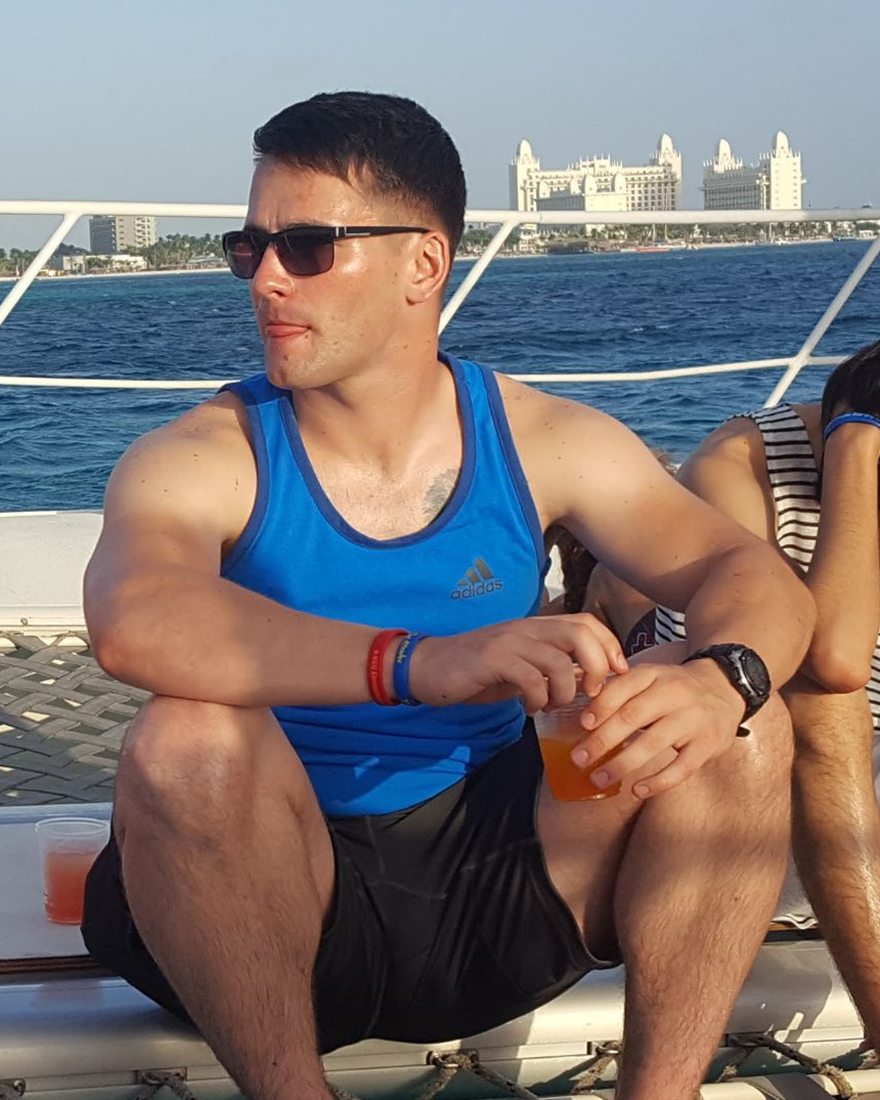
I run a happiness brand. My first piece of advice is to stop chasing happiness.
Here's how I learned that the hard way, and what I do instead.
Here's how I learned that the hard way, and what I do instead.
Hi, my name is Alex Romano.
I'm a former Marine, a current Navy Reservist, and the founder of Ludic Living. I've spent the last 15 years trying to understand happiness, mostly by getting it wrong first.
My freshman year of high school, I got straight A's. That was a big deal for me. I don't remember getting good grades in middle school, and everyone kept telling me that grades decide which college you get into, which decides how much money you make, which decides how your life turns out.
Then, sophomore year, something switched off.
I stopped trying. I got an A in band and C's in almost everything else. I failed two semesters of English and one of History because I didn't do my homework, showed up late, or skipped school entirely. Most days I locked myself in my room and played video games.
If you'd asked me back then, I wouldn't have told you I was depressed. I didn't know. Years later, my mom showed me a drawing I'd made in high school. It was me, on my knees, crying. I remember staring at it and thinking, whoever drew this picture was going through something rough. I could quite literally feel the sadness coming off the paper.
I don't remember feeling that way. But I believe the kid who drew it.
I've since learned this is a common phenomenon. People drift through life without paying attention to how they feel inside, and one day they wake up and realize they haven't been happy in a long time. It's been so long that they don't remember what happiness even feels like. And they certainly don’t know how they lost it.
Senior year, my friends started talking about the colleges that had accepted them. I hadn't even applied. I took the SAT and the ACT, but never sent in a single college application.
I almost didn't graduate at all. To make up for my failed classes, I had to finish a stack of night school workbooks and pass the accompanying tests. I put it off until the final two days, then stayed up for 36 hours straight on caffeine, filling in workbooks, then walked into night school to take all three tests back-to-back on the last day I was allowed to take them.
I passed, barely graduating high school. Without that, I'd have been stuck in my hometown, which I had already felt stuck in.
Back then, I honestly believed that without college, my only options were working at a gas station, flipping burgers, or waiting tables. I didn't know how big the world was.
Then, one day, a friend needed a ride. I had my dad's old Ford Expedition — a hand-me-down he'd given me when he upgraded — and my friend needed to get to the military recruiter's office for physical training. On the way, he asked what my plans were after high school. I told him I didn't have any. He asked if I'd ever thought about the military.
I hadn't. But I was curious enough to talk to the recruiter. The recruiter talked to me about a steady paycheck, seeing the world, wearing a uniform, and joining the best fighting force on the planet. For the first time, I could picture a future for myself. I felt something I hadn't felt in years: a sense of direction.
I enlisted in the United States Marine Corps in September 2013.
After making the decision to join, it certainly was not all sunshine and rainbows. You can't go to Marine Corps boot camp if you can't even do a single pull-up. Yet, here I was, overweight and had never worked out a day in my life. I couldn't even do one.
So I trained until I could. I went to boot camp being able to barely crank out one pull up. By the end of boot camp, I was able to do 15. By the end of my contract, I could do 23.
I set a goal to earn a leadership role in my work section, and as a Lance Corporal I was made the operational lead in charge of Marines, Sailors, Soldiers, and Airmen who were sometimes two and three ranks above me. Then I got so good at the job, they pulled me off the watchfloor to train the new joins.
Looking back, every part of my psyche was being fed. I was challenged, I was good at what I did, I was surrounded by people I trusted, and I was part of something bigger than myself. I didn't know that was why I felt so good. All I knew at the time was that I was happy.
And here's the part that took me years to notice: While I was busy building my life, I wasn't thinking about happiness at all. My attention was too occupied to even care whether or not I was even happy.
Growing up, my dad stressed the importance of a good job and good money. My mom always talked about how much happiness mattered. Somewhere along the way, I put those two together — I believed that money was the vehicle that would get me to happiness.
My dad worked hard to bring more money into our family. Eventually, he went to prison for embezzling $5.4 million and served a prison sentence of three and a half years. Not having him around for that long left a mark on my psyche. It taught me that money made the wrong way wasn't worth it, and it's a big reason today why I'm so careful to stay honest and ethical, even when it means making less money in the short term.
But still, I believed money was the answer. So in 2017, when I pulled into the parking spot outside of my apartment, after my commute from work — and realized I couldn't remember a single moment of the drive home — I knew something was wrong. It felt as though I was living my life completely on autopilot. It’s like I suddenly realized I had fallen into a routine, and something about the scenario made me feel empty inside. It was like all of the joy and fulfillment had been sucked out of me.
Sometime after this “parking episode”, a Facebook ad popped up in my internet browser, showing me a few “seemingly happy” people traveling the world on income they earned from online business. The ad was painting a picture of financial freedom, and I decided — then and there — that financial freedom and control over my time were what I was missing. If I had what they had, I believed that I would be happy too.
Over the next seven years, I started and abandoned 12 businesses, spent more than $76,000 on courses and coaches, ended up deep in debt, and neglected my health to the point of being overweight again. To make matters even worse, my marriage came to an end. I got a divorce.
(NOTE: There’s so much more to the details behind my story, but I’ve already gone over a lot of these details in other places on my website. Rather than repeat what was written there, I’ll link you to it. Just click the button below.)
At the worst of it, though, the suffering got so heavy that I seriously considered ending my life.
What kept me alive was a simple thought: ‘I don't know what happens after we die’.
The way I look at it: Maybe there's an afterlife, but also maybe there isn't. Maybe there’s a God, but also maybe there is not. The only way to know for sure is for me to die. But since I haven’t died (yet), I cannot claim to know. So, therefore, I see it as being totally possible that this might be the only life I ever get to live. And if it is, I want to make the most out of it. Not waste it away.
My depths of despair feel like a distant dream now. But I remember enough of it that I now have a deep compassion for anyone who is in that place today.
When you constantly ask the question, “How do I become more happy?”, you're essentially telling yourself that something inside you is missing. And besides, that question has a million possible answers depending on who you ask. When faced with that many options and possibilities, you become afraid of picking the wrong one. Most people freeze.
Instead of the above question, ask yourself: “Which area of my life — if it improved — would make the biggest difference, and what can I do about it to make a change right now?” There are far fewer realistic answers to that question, which makes it much easier to act. And once improvement becomes the goal, you’ll find that the game never ends. You're always starting from a new place with something new to work on, so you become preoccupied and stop thinking about your personal happiness. Then one day you lift your head, look around, and realize how far you've come. And it is the progress which helps you feel more alive.
If you don't enjoy the way you're achieving your goals, getting there won't fix how you feel. I learned this with money. I chased after entrepreneurial ideas in which I had no business being simply because I didn’t enjoy the work. Choose the type of work that energizes you, and the reward on the other side becomes a bonus instead of the only point.
Most of the suffering I see comes from trying to control things nobody can control. I don't sort my days into “good vs. bad”. Instead, I just wake up, deal with what's in front of me, and keep building the life I want to live.
Some of my favorite movies are the ones that make me cry. You need the full range of human emotion in order to truly experience life. Without sadness, you'd be unable to comprehend happiness. You need to attract the opposite of something into your life in order to understand what that thing even is.
Honestly, nothing. He wouldn't have listened.
Instead, I'd ask him a question: “When have you felt most alive?”
I'd have him describe the pride of finishing boot camp, the satisfaction of leading his work section, and the feeling of being recognized for being good at his job. Then I'd ask him what those moments had in common.
It wasn't the money. He was getting paid, sure, but that's not what made him happy. What made him happy was having something to work toward and getting better at it. By 2017, he'd reached his goals and stopped setting new ones. Without direction or growth, he fell into a routine, and the routine is what felt empty.
That question — Where does your happiness come from? — is at the heart of everything I teach.
The word “Ludic” comes from the Latin word for “play”. But play doesn't always look cheerful. Watch a professional athlete in the middle of a game and you'll see someone dead serious, completely focused. That's play too.
The trick is to take the game seriously while you're on the field, then let it all go once the timer hits zero. Don't let the outcome follow you home and swallow the rest of your life.
I also don't believe there's even one right way to live. Leonardo da Vinci threw his whole being into his work, and I doubt he'd have wanted it any other way. What matters is being able to live your life the way you want to live it.
Ludic Living is for people who have achieved what they set out to achieve and found the feeling of emptiness on the other side of the finish line. It is for the people who are quietly asking, “Is this really all there is?”
My honest answer is, “Yes, this is life.” But that's not bad news. There's no perfect, happier version of life waiting somewhere for you to unlock. There's only a life that is more or less aligned with what you want, and you can build that life, starting from wherever you are. Starting right now.
What I know comes from my own experience. What I believe comes from the best evidence I can find, but it’s not necessarily based on anything tangible or concrete. This delineation keeps things simple. When I find out I'm wrong, I change my mind. No fuss involved. Because I don’t attach my identity to things I cannot say for sure I know.
Because once you know the cause of a problem, the solution usually becomes obvious. When I don't know the cause of an issue, I commit to running experiments until I find an answer.
Ludic Living isn't a substitute for professional mental health care. I’m not here to simply listen to how much you hurt. I look for solutions to problems, and I challenge you to act.
Today, I serve in the Navy Reserve. I'm good at it, it pays decent, and it funds the business I'm building. I don't plan to stay in the military forever, but I like being useful and competent while I build what comes next.
Outside of work, I study philosophy, because understanding how the world works is the only way to know what you can control. I stay in shape because I like how it makes me feel. I play video games and watch movies because I love seeing how other people express themselves creatively. And I like to spend my time being around other people.
My biggest fear isn't failing. It's reaching the end of my life with regrets because I never gave my dreams a real shot. So if I wake up and get to work on something I care about, I consider myself as having won the game for the day. And the beautiful thing about this mindset is, it gives me another chance to win again tomorrow.
If you've been chasing happiness and find it keeps slipping away, I invite you to enter into my world. I’ve likely been where you’ve been and can share my insights to help guide you back into the light.
Begin your journey towards happiness →
Thanks for reading. Here's to making the most of the one life you know you get.